Digital Currencies and Monetary Policy: Will Central Bank Digital Currencies Reshape Control Over Money?
By Arjun Shekdar
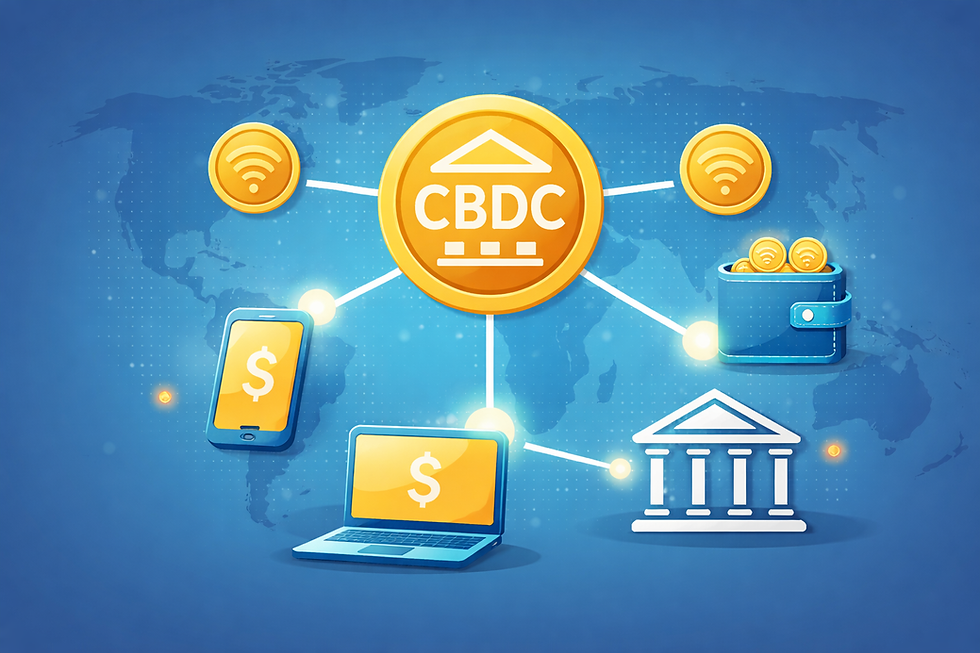
We all live with and are familiar with money on a daily basis, be it cash, debit cards, or services like Venmo and PayPal. Now imagine your government's central bank printing its own official digital currency. Would this transform the way we make payments, the way our governments manage the economy, and the future of money? This is not some crazy idea—this is already underway. China has experimented with its "digital yuan," the Bahamas has a "Sand Dollar," and the U.S. Federal Reserve is examining something called a digital dollar. But governments would go through the trouble of coming up with something so new. Why? Good old cash and internet banking are more than sufficient. It seems like there are just heaps of positives with central bank digital currencies, or CBDCs, but are they really a good idea for all of us? Let's have a look at the advantages and disadvantages of CBDCs.
What are the Best Things About CBDCs?
Central banks give numerous reasons for requiring digital money, but three of the biggest are: enabling more individuals to possess money, giving central banks more power over the economy, and making payments easier and more secure.
The first big benefit is financial inclusion. Across the world, there are billions of individuals without a bank account. That excludes them from saving, borrowing, and even getting help from their governments. A CBDC could reverse that because people wouldn't need a bank account—they'd just need their central bank mobile app or electronic wallet. Nigeria, for example, launched the eNaira partly to help citizens who lack access to banks. More people could receive things like government aid or family remittances straight away with CBDCs. As more people enter the financial system, it makes the economy stronger as a whole.
The second big benefit is tighter monetary policy. Today, central banks are adjusting interest rates or printing money to manage the economy, but those tools don't always work instantly. With CBDCs, central banks could potentially respond more directly. Just imagine if during a recession the government could deposit stimulus payments directly into people's digital wallets instantly. They can even construct "smart money" that encourages people to spend in periods when the economy must be stimulated. This gives central banks sharper and faster instruments for managing growth, inflation, and stability.
The third benefit is faster and safer payments. The current money-transfer systems are expensive and slow, especially cross-border. CBDCs could render payments nearly instantaneous, both locally and internationally. For example, funds from America to a relative abroad could be transferred instantly, not after days, and for a fee that is close to nothing. Secondly, since the central bank issues CBDCs, it's harder to counterfeit them and use them for fraud. If digital payments already form the new norm in this world, then CBDCs can take this to the next level being faster and more secure.
With all these benefits, CBDCs sound great. But as usual, there is another side of the story.
What are the Worst Things About CBDCs?
Even though CBDCs have some very solid positives, they also have two major negatives: privacy concerns and hurting the banking system.
The first is privacy. Cash is private—you can spend it and no one has to know what you bought. CBDCs are digital, so the government could track every transaction. Even if bureaucrats promise to respect people's privacy, it's hard for everyone to trust in that. Imagine the government being able to see every single cup of coffee you buy, every movie ticket, or even every single donation you make. For some people, that level of control would be an intrusion into personal freedom. Instead of putting people on safer ground, CBDCs could end up making people more fearful of their money.
Bank disruption is the second issue. Commercial banks presently play a gigantic role to lend, enable business, and guard savings. If people withdraw money from the bank to deposit into CBDCs, banks would suffer from loss of deposits. Without those deposits, they could not lend as much, which would hurt families and businesses that need loans. In this extreme scenario, if there was a banking crisis and everyone rushed to invest in CBDCs because they seemed "safer," banks could even fail. That would be monstrous instability and could do more harm than good.
Do CBDCs Really Redefine Control Over Money?
So do central bank digital currencies really revolutionise the function of money and how governments control economies? Yes and no. In the short term, they are quite promising. They can empower the unbanked, give governments faster tools of action, and speed up payments and secure them. But in the long term, there are negatives to be found. Privacy can disappear, trust in government money can evaporate, and banks can lose their purpose to fuel expansion.
It depends on how CBDCs are built. If countries build good privacy protections and allow banks to continue doing their work, then yes, CBDCs could redefine money in a good sense. But if governments hurry forward without good regulation, CBDCs could cause more harm than good. For now, the answer is kind of "yes"—CBDCs could redefine control over money, but only if countries are extremely careful about how they build them.
Works Cited
Bank for International Settlements. Central Bank Digital Currencies: Financial Stability Implications. BIS, Sept. 2021, https://www.bis.org/publ/bppdf/bispap117.htm.
Board of Governors of the Federal Reserve System. Money and Payments: The U.S. Dollar in the Age of Digital Transformation. Jan. 2022, https://www.federalreserve.gov/publications/money-and-payments-discussion-paper.htm.
International Monetary Fund. “Central Bank Digital Currency: A New Tool in the Financial System?” IMF Blog, 20 July 2023, https://www.imf.org/en/Blogs/Articles/2023/07/20/central-bank-digital-currency-a-new-tool-in-the-financial-system.
Atlantic Council. Central Bank Digital Currency Tracker. Atlantic Council, 2025, https://www.atlanticcouncil.org/cbdctracker/.
Reuters. “China Expands Use of Digital Yuan in 2023.” Reuters, 11 Jan. 2023, https://www.reuters.com/markets/asia/china-expands-use-digital-yuan-2023-01-11/.
World Bank. The Role of Digital Money in Financial Inclusion. World Bank, 2022, https://www.worldbank.org/en/news/feature/2022/10/12/the-role-of-digital-money-in-financial-inclusion.


Comments